
Start with the codes you own.
A covers yellow and orange, B green, C blue, D purple, E pink, F red, G brown, H neutrals and M muted tones. These family names are browsing aids. Use Available colors to exclude beads you do not own.
THE LITTLE DETAILS, ALL IN COLOR.
Search the MARD 221 color chart by bead code, HEX or color family. This standard screen-reference palette is also built into the BeadColor editor.
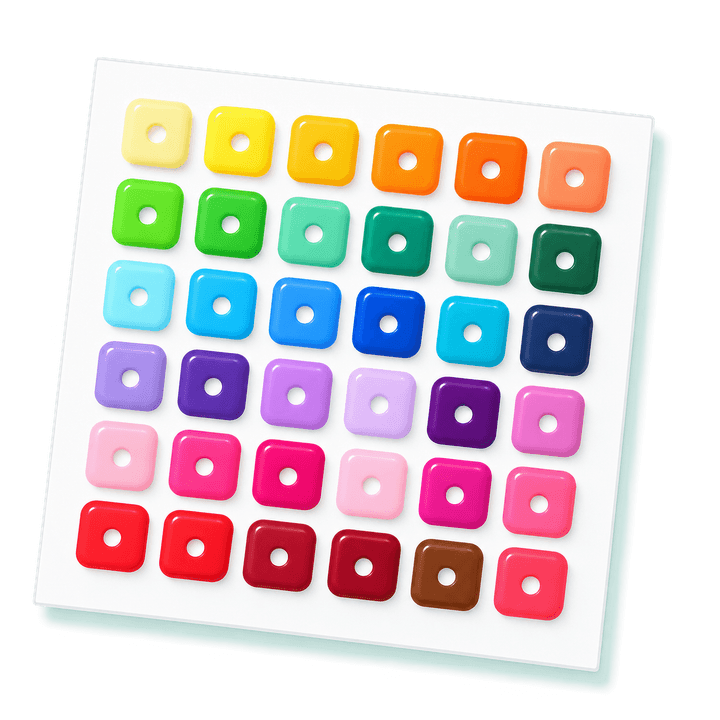
Pick a swatch to see its code and color values.
FROM SWATCH TO PEGBOARD
Find a code, compare the screen reference and plan with the beads you have.
Open Bead editorA covers yellow and orange, B green, C blue, D purple, E pink, F red, G brown, H neutrals and M muted tones. These family names are browsing aids. Use Available colors to exclude beads you do not own.
Compare warm lights in A and G with softer E shades. Keep a highlight, a midtone and a shadow. Too many similar H and M shades can hide detail rather than improve it.
A white bead still fills a grid cell. Clear cells in the editor to create holes or remove the background. A flat swatch does not establish whether a physical bead is transparent.
GOOD TO KNOW
Yes. The leading zero is a formatting choice. We display A01 for consistent sorting, but you can search either A1 or A01.
The 221-color library covers A–H and M. Our 291-color library preserves those same 221 values and adds 70 community reference colors across P, Q, R, T, Y and ZG.
Screen values help you plan a palette. Lighting, your display, bead finish and production batch can change what you see. Confirm your choice with the supplier’s physical color card before ordering.
Screen reference · 221 colors · 9 code families. Source files retrieved October 21, 2026; this is not a claim that the reference is the manufacturer’s latest complete range.
Public screen reference cross-checked against WebFEM and Anqstar on September 14, 2026. Not manufacturer spectral measurements.
Full data attribution and licensesBeadColor is an independent tool and is not affiliated with these bead manufacturers.